
Why You Should Stop Using 'Community' to Describe Everything
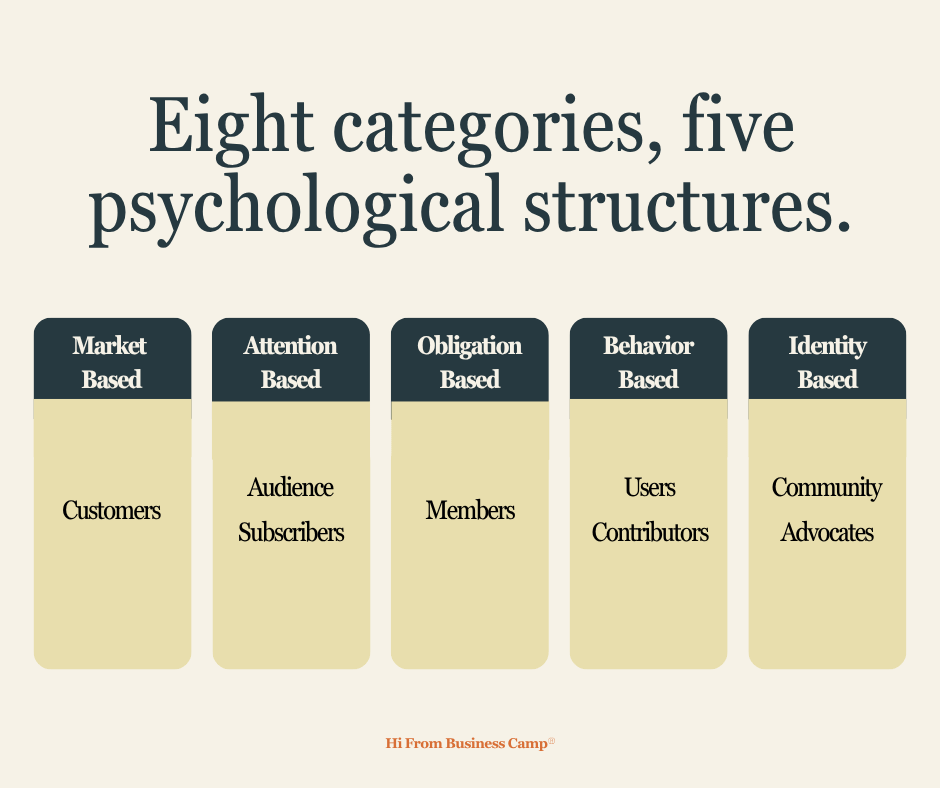
Eight categories, five psychological structures, and what each means for how you monetize.

There is a word that has lost its meaning.
Builders use it to describe newsletter lists, Instagram followings, Slack workspaces, paid tiers, and event attendance.
The word is community, and it has been applied to so many things that it no longer means any of them precisely.
Before we get into it, let’s be very clear:
Community is not a word to avoid, but it is a word to earn.
The problem is not that builders use it; it’s that they use it before they have built the thing the word actually describes.
When the psychological structure of a group is misread, decisions follow from that misreading.
Infrastructure gets built for a relationship that doesn't exist.
Metrics get optimized for behavioral signals like sessions and clicks that say nothing about identity, belonging, or lateral connection.
Asks get made that require a psychological commitment the relationship was never built to produce.
This is a predictable outcome of building inside an environment where every kind of human relationship looks exactly the same, whether that person is a casual follower, a loyal member, a daily user, or a genuine advocate.
A principle known as Goodhart’s Law suggests that when a measure becomes a target, it ceases to be a good measure (Goodhart, 1975). For builders, this means follower counts, once optimized for, tend to produce followers rather than the relationships those followers are assumed to represent.
Nowhere does this cost more than at the moment of monetization, when you ask people to pay, to recruit, to commit, or to stay, and discover that the number you have been tracking was never a reliable measure of any of those things.
Why the path to monetization isn’t linear.
Digital platforms tend to optimize for conversion.
Every relationship, whether it’s attention, belonging, obligation, or identity, gets funneled toward a transaction. That architecture makes it easy to assume that people move through these categories in order, from follower to subscriber to customer to advocate.
They do not.
Someone can become a paying customer before they have ever subscribed to anything you make, because subscribing and purchasing are independent actions.
A contributor can become a vocal advocate without ever having paid for anything. A great example of this is open source communities, which run entirely on people who contribute to a project, become deeply identified with it, and recruit others without a transaction ever occurring.
Research on social identity shows that the identity formed through belonging persists even when the behavior that produced it stops (Tajfel & Turner, 1979). Someone can stop using a product entirely, switch to a competitor, move on, change jobs, and still identify strongly with the community they found through it.
That path might skip five of the eight categories entirely.
You cannot engineer the sequence.
You can only create the conditions that make the shift possible when someone is ready for it.
Eight groups, five psychological structures.
The eight categories that follow sort into five distinct psychological structures.
Each one tells you something different about what motivates the people in it, what they expect from you, and what they will and will not do.
Making a commitment promotes follow-through, but only to the degree that someone feels genuinely bound to it.
Market Based: Customers
Customers are people who have completed a transaction with you.
They bought a product, paid for the subscription, hired you for the project or service.
A transaction is a straight exchange: money for access, money for a product, money for a service.
The psychological relationship is shaped by market norms, characterized by efficiency, impersonality, and contingency on value received (Heyman & Ariely, 2004).
The mistake is assuming that because someone paid you, they feel connected to you.
That is not necessarily true.
Customers are evaluating the exchange.
When the value stops for that customer, so does the relationship.
Attention Based: Audience and Subscribers
An audience is made up of people who receive what you broadcast. Someone who finds your article through a Google search, watches a YouTube video because the algorithm recommended it, or reads a post because someone else shared it.
The relationship is one-directional.
They consume what you produce and have no obligation to you whatsoever.
Audience is the right structure for reach, awareness, and education.
The mistake is expecting reciprocity, loyalty, or identity from a group whose psychological relationship with you is fundamentally passive.
Subscribers on the other hand have taken one step further than an audience member: they opted in.
Someone who watched your YouTube chose to follow your channel.
A newsletter subscriber handed you their email address.
In both cases, you have direct access that an audience member never granted you.
The act of opting in creates a small psychological commitment that tends to influence subsequent behavior. People generally act in ways consistent with the commitments they have made, even minor ones (Cialdini, 1984).
This makes subscribers psychologically warmer than a general audience, but they have not paid you anything, they have not committed to anything beyond giving you access to their inbox, and that access can be revoked at any time.
Obligation Based: Members
Members are people who have joined something with explicit terms, obligations, or roles. Think REI or a professional association.
The defining feature is reciprocal obligation.
When people enter an arrangement with stated commitments on both sides, both parties are operating under a fundamentally different kind of agreement than a transaction (Rousseau, 1989).
They have responsibilities. So does the organization.
REI members pay a one-time lifetime fee of $30, and that fee comes with voting rights, profit sharing, and a say in how the co-op is run (REI Co-op, 2025).
It’s not a transaction; it’s an agreement.
Reducing that kind of relationship to money in exchange for access can collapse the social norms that hold it together, with no guarantee of recovering them afterward (Heyman & Ariely, 2004).
It’s important to note that not everything called a membership is one.
A gym calls it a membership, but by the psychological contract definition, it’s a transaction: you pay, you get access, and neither party has obligations beyond that exchange.
The label implies belonging.
The structure doesn’t necessarily deliver it.
Behavior Based: Users and Contributors
Users are people who interact with a product or system. Think someone using Notion’s free plan to organize their personal projects, or listening to Spotify with ads.
Their relationship is defined by behavior inside an interface rather than by identity, transaction, or belonging.
What keeps them there is whether the product does what they need it to do.
Engagement metrics like sessions, clicks, and time on site track that behavior, but they are not measures of belonging, trust, or identity. A product can be extremely sticky and still have none of those things.
Users have not paid you anything in many cases, and even when they have, the relationship is contingent on the product continuing to work for them.
Converting a free user to a paying customer requires a clear utility case.
The paid tier has to be meaningfully better than the free one, and when it’s not, users stay free or leave.
Contributors are people who create value inside your ecosystem for others without a direct transaction. Open source communities are full of examples of people who write documentation, answer forum questions, and build integrations without being paid.
What drives them is not money but autonomy, competence, and relatedness, the three core drivers of intrinsic motivation, meaning motivation that comes from within rather than from external rewards like payment or recognition (Ryan & Deci, 2000).
Because their motivation is intrinsic rather than financial, they are among the most fragile relationships you have.
Governance decisions, platform changes, and shifts in tone can undermine those conditions in ways that a purely transactional relationship would not, and paying contributors can make things worse, not better.
In a field experiment, volunteers who were paid a small amount worked fewer hours than those who received nothing at all (Frey & Goette, 1999). Once you start paying someone for something they were doing for free, they start thinking of it like a job. Jobs have different rules than volunteering. When you do something for free, you show up because you want to and put in as much as you feel like. When you get paid, you do what the payment covers, and no more. The payment turned an open-ended personal commitment into a transaction, and transactions have boundaries.
Identity Based: Community and Advocates
Community is made up of people for whom membership in the group has become part of their self-concept. Humans derive a meaningful portion of their identity from group membership, and the groups we belong to are not just social arrangements but constituent parts of who we are (Tajfel & Turner, 1979).
True community members have lateral relationships with each other, not just vertical relationships with you, and that lateral infrastructure is what makes community resilient in a way that the audience never can be (McMillan & Chavis, 1986).
When community is real, you do not have to earn loyalty through constant value delivery because the identity does a significant amount of that work.
Calling an audience a community and then failing to build infrastructure for lateral connection is promising an identity and delivering a broadcast.
On the monetization side, identity-based relationships are the most commercially durable of the eight categories, but also the most fragile when the wrong kind of transaction is introduced.
Charging for access to a community built on belonging rather than exchange can collapse the psychological contract that held it together, with no guarantee of recovering it afterward (Heyman & Ariely, 2004).
Advocates are people who have incorporated you into their self-concept to the point where they recruit others.
When a brand becomes intertwined with how someone understands themselves, they will actively defend and extend it.
Applied to communities and causes, advocacy becomes an expression of identity rather than a deliberate act of promotion (Escalas & Bettman, 2003).
Treating a satisfied customer or an engaged subscriber as a word-of-mouth engine before that identity connection has actually formed is likely to reveal exactly how transactional the relationship actually was.
Referral programs and affiliate schemes attempt to monetize advocacy, but they risk converting an identity-based relationship into a transactional one.
The same dynamic that makes paying volunteers counterproductive applies here.
Once advocacy starts to feel like a job, the motivation that made it genuine is the first thing to go (Frey & Goette, 1999).
What monetization actually requires.
Every category has a different monetization logic, and applying the wrong logic to the wrong category is where most monetization strategies break down.
Audience
Audience is best monetized through advertising or sponsorship.
A brand pays to reach the attention you have built, a podcast sells ad slots, a newsletter sells sponsored placements, a YouTube channel runs ads before its videos.
The transaction is with a third party, not with the audience itself.
The reason direct monetization of audience is so difficult is that the audience member has made no prior commitment to you: no opt-in, no purchase, no identity connection.
Asking an audience to pay is the first ask you have ever made of them, with no groundwork laid to support it.
Subscribers
Subscribers are warmer than audience because the opt-in created a small psychological commitment.
The act of committing to something, even in a minor way, makes subsequent action in the same direction more likely (Cialdini, 1984).
But that commitment is weak.
According to Substack’s own published data, most publications convert 1-3% of free subscribers to paid, meaning up to 97% of people who liked your work enough to subscribe did not pay for it.
Non-conversion is often a relationship problem rather than a messaging one.
The subscriber has not yet made the shift that a transaction requires.
The path to improving conversion is giving subscribers enough reasons to feel invested before you ask them to pay: replies, exclusive access, content that feels written specifically for them (Cialdini, 1984).
Customers
Customers need continued value to stay because their relationship with you is governed by market norms, meaning relationships driven purely by price and value received, with no social obligation on either side (Heyman & Ariely, 2004).
A past transaction is not evidence of a future one.
Every renewal, upsell, and subsequent ask gets evaluated on its own terms.
The mistake is treating a completed transaction as a signal of loyalty when it’s actually a signal of a single satisfied evaluation.
Members
Members are already in a monetizable relationship because the mutual agreement they entered, where both sides have real obligations, includes a financial dimension from the start, so a payment feels consistent with the relationship rather than alien to it (Rousseau, 1989).
REI’s model illustrates what this looks like at scale: 24 million members pay a one-time $30 fee in exchange for voting rights, profit sharing, and community, and in 2017 alone REI returned $196.3 million to members through dividends (REI Co-op, 2017).
The fee works because it’s part of a reciprocal agreement, not a price for access.
The risk is introducing upsells that reduce membership to money in exchange for access, because once a relationship governed by social obligation starts to feel like a straight transaction, the social norms that held it together can collapse with no guarantee of recovering them afterward (Heyman & Ariely, 2004).
Users
Users convert when there is a clear reason to pay.
The relationship is behavioral.
What keeps users is whether the product does what they need it to do.
Approximately 40% of Spotify’s active users are premium subscribers, because the paid tier meaningfully changes the experience: no ads, better audio quality, offline listening.
The reason to pay is obvious.
Substack writers converting at 1-3% are typically offering more content behind a paywall, which is a weaker reason to pay because the free content already demonstrates what the paid content will be.
When the reason to pay is not obvious, improving the product is a more reliable path than improving the outreach.
Contributors
Contributors should not be paid directly for what they are doing voluntarily.
The principle behind this is the same one that explains why paying volunteers reduces their hours: introducing money into a relationship driven from within changes how someone understands why they are doing it, and once an external reason exists, the internal one weakens (Frey & Goette, 1999).
Red Hat built a business acquired by IBM for $34 billion by selling enterprise support and services around Linux, charging enterprises for reliability, maintenance, and deployment rather than for the code itself (IBM, 2019).
Create conditions where the contribution generates value for others, and capture that value through the product or platform, not by paying the contributors directly.
Community
Community monetization works when it’s adjacent to the community: events, credentials, tools, or services that extend the identity rather than gate it.
The reason charging for access to the community itself fails is that the relationship is built on belonging, not exchange.
Introducing a transaction into a relationship built on social obligation can replace those social norms with market norms, with no guarantee of recovering the relationship afterward (Heyman & Ariely, 2004).
Research suggests that when group membership is part of someone’s self-concept, anything that makes that membership feel conditional or transactional threatens the identity itself (Tajfel & Turner, 1979).
Advocates
Advocates cannot be bought.
Referral programs and affiliate schemes introduce a transactional frame onto a relationship built on identity, and the same pattern identified in paid volunteers is likely to apply here.
Once advocacy starts to feel like a job, the motivation that made it genuine is the first thing to go (Frey & Goette, 1999).
Research on self-brand connection found that people defend and extend what they are connected to because it reflects who they are, not because they are compensated for it (Escalas & Bettman, 2003).
The right approach is to deepen the identity connection through recognition, co-creation, and genuine inclusion in what you are building, not to put a price on the recruiting behavior itself.
What you call it matters.
The word you use to describe the people around your work is not just a label. It’s a decision about what you are building, what you will measure, and what you will ask of them.
Misname the group, and you will misread the relationship.
Misread the relationship, and you will misallocate the effort.
Misallocate the effort long enough, and the gap between what you built and what you were trying to build will become impossible to explain.
The same person can occupy more than one category at the same time. Someone can be a user, a subscriber, and an advocate simultaneously. The categories describe the nature of each relationship, not a fixed identity. What matters is knowing which relationship you are activating when you make an ask, because each one supports a different kind of ask.
Of all eight categories, community carries the heaviest psychological weight.
It’s the one that promises identity, lateral connection, and belonging, and the one that costs the most when the promise is not backed by the structure.
Calling something a community that is not one does not just set the wrong expectations. It makes asks the relationship was never built to support.
The categories in this piece are not academic. They are the difference between building something that compounds and building something that plateaus.
Sources:
Cialdini, R.B. (1984). Influence: The Psychology of Persuasion. HarperCollins.
Escalas, J.E., & Bettman, J.R. (2003). You are what they eat: The influence of reference groups on consumers’ connections to brands. Journal of Consumer Psychology, 13(3), 339-348.
Frey, B.S., & Goette, L. (1999). Does pay motivate volunteers? Working paper, Institute for Empirical Economic Research, University of Zurich.
Goodhart, C. (1975). Problems of monetary management: The UK experience. Papers in Monetary Economics, Reserve Bank of Australia.
Heyman, J., & Ariely, D. (2004). Effort for payment: A tale of two markets. Psychological Science, 15(11), 787-793.
IBM. (2019). IBM closes landmark acquisition of Red Hat. Retrieved from ibm.com/news.
McMillan, D.W., & Chavis, D.M. (1986). Sense of community: A definition and theory. Journal of Community Psychology, 14(1), 6-23.
REI Co-op. (2017). Annual Stewardship Report. Retrieved from rei.com/newsroom.
REI Co-op. (2025). Membership. Retrieved from rei.com/membership.
Rousseau, D.M. (1989). Psychological and implied contracts in organizations. Employee Responsibilities and Rights Journal, 2(2), 121-139.
Ryan, R.M., & Deci, E.L. (2000). Self-determination theory and the facilitation of intrinsic motivation, social development, and well-being. American Psychologist, 55(1), 68-78.
Substack. (2023). Going paid guide. Retrieved from substack.com/going-paid-guide.
Tajfel, H., & Turner, J.C. (1979). An integrative theory of intergroup conflict. In W.G. Austin & S. Worchel (Eds.), The Social Psychology of Intergroup Relations (pp. 33-47). Brooks/Cole.